14.9.2026
Relieve your neck, don't strain it: what matters in yoga and Pilates
Relieve your neck, don't strain it: what matters in yoga and Pilates.
The neck is rarely the goal of a position. Hardly anyone goes to a class to work on their cervical spine. Yet it is involved anyway, in almost every position, from the first time you sit up tall to the final lying-down position.
It's worth understanding, for two reasons. Neck pain is one of the most common pain problems of all: in 2020 around 203 million people worldwide were affected, women more often than men, peaking between the ages of 45 and 74. At the same time, movement is among the most effective things there are against it, and yoga and Pilates are movement with a lot of attention on exactly this region.
This article explains what role the neck plays in practice, where load actually arrives, what that means for technique, and what to do when it hurts.
Why the cervical spine has a special position
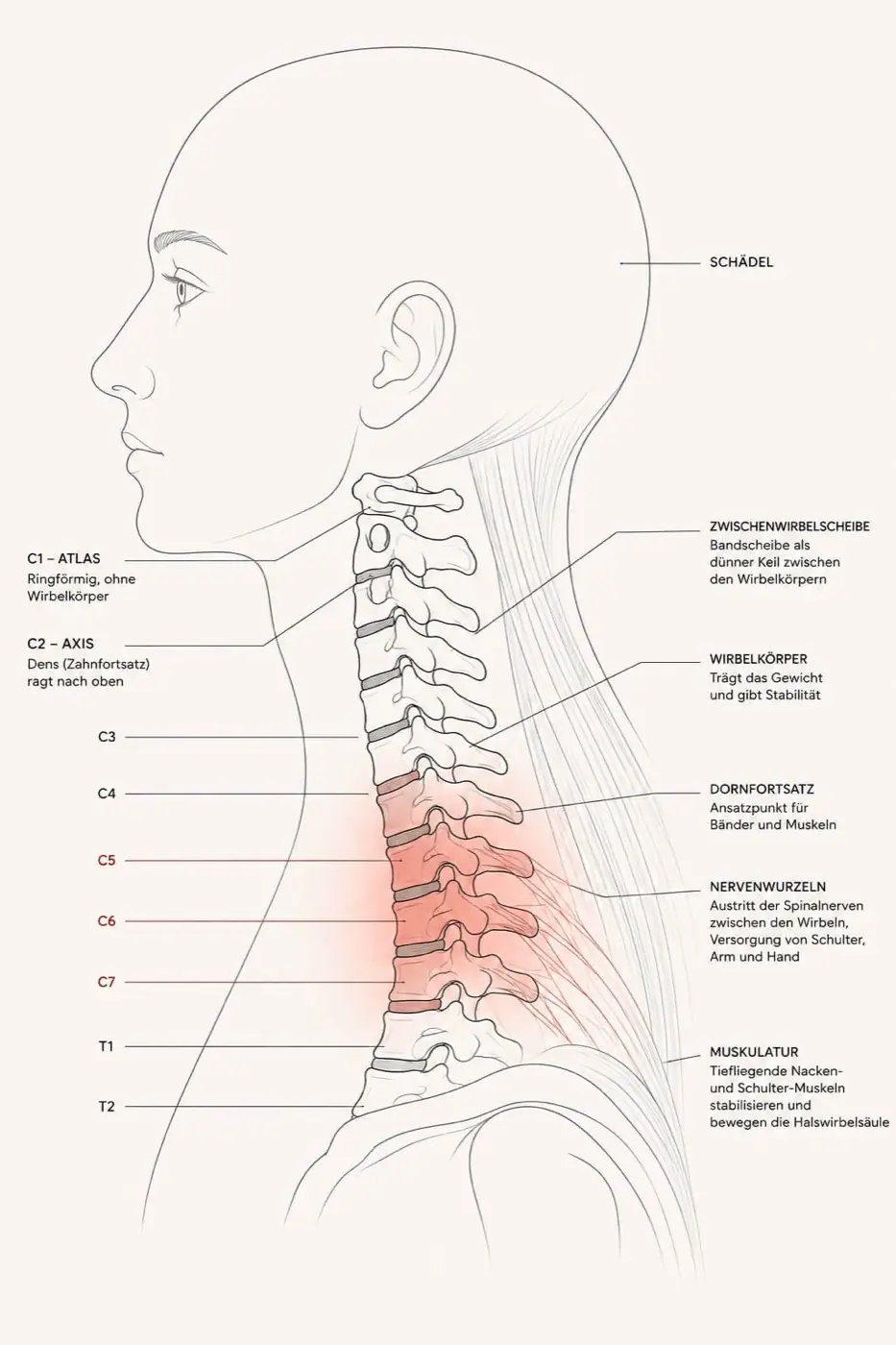
Seven vertebrae carry the head, allow rotation, tilting and extension, and at the same time protect the spinal cord and the exiting nerve roots. No other section of the spine is as mobile, and none is as little secured by ribs or pelvis.
A few details that explain the practice:
- The top two vertebrae are specialists. The atlas (C1) carries the head and has no vertebral body at all; the axis (C2) carries the dens, around which the atlas rotates. Around half of all head rotation takes place between these two alone.
- The first intervertebral disc lies between C2 and C3. There is none between C1 and C2; a pure pivot joint works there.
- Only the cervical spine has uncinate processes, small bony ridges on the sides of the vertebral bodies. They guide movement and limit sideways gliding. 4.
- The nerve roots C1 to C7 exit above the vertebra of the same name, C8 below C7. With symptoms radiating into the arm, the distribution of symptoms can give clues to an affected nerve root, but on its own it doesn't allow a clear attribution.
THE NECK IN EVERYDAY LIFE AND ON THE MAT
It carries. The head weighs around four to five kilograms, about eight per cent of body weight. When upright, it sits almost vertically above the spine and the holding work is low. As soon as it tilts forward, the lever gets longer and the muscles have to work harder against it. And as soon as body weight is added, in weight-bearing positions or inversions, the neck is no longer carrying just the head.
It orients. The deep neck muscles are among the most sensor-rich muscles in the body: the small muscles directly below the back of the skull contain significantly more movement sensors than, say, the shoulder or thigh muscles. Together with the eyes and the organ of balance, they constantly report where the head is in space. This information is the reference for everything else: for balance, for alignment, for knowing which way is up. In people with persistent neck pain, exactly this is measurably altered: they are worse at finding a given head position, and balance and eye movements change too.
It breathes along. The scalenes on the side of the neck are active even during quiet breathing. The sternocleidomastoid muscle joins in as soon as the work of breathing increases: in flow, in the heat, under exertion. If you feel a pull in your neck after an intense class, you often haven't practised wrongly, you've simply breathed a lot.
Put together: the neck is involved in almost every position. Only thinking about it in shoulder stand falls short.
How much work actually arrives
This is where it gets uncomfortably honest: there are hardly any reliable measurements of the load on the cervical spine in individual yoga and Pilates positions. There is one.
In headstand, 40 to 48 per cent of body weight rested on the head of practitioners. The share increased the longer the position was held, because weight slowly shifted from the arms into the head. So it's not only the entry that matters, but how long you hold it.
There is no comparable data for shoulder stand, plough or Chaturanga. What can be said anatomically: in shoulder stand, body weight rests on the shoulders and neck while the cervical spine is close to its maximum flexion. When holding the head up in Pilates, it's not the height but the duration and number of repetitions that challenge the deep neck flexors.
What matters is what this ranking does not say: more load doesn't automatically mean harmful. Resilient tissue can handle load; that's the point of training. The ranking only says where attention, gradual build-up and dosage pay off most.
What this means for technique
Four principles that run through almost all positions:
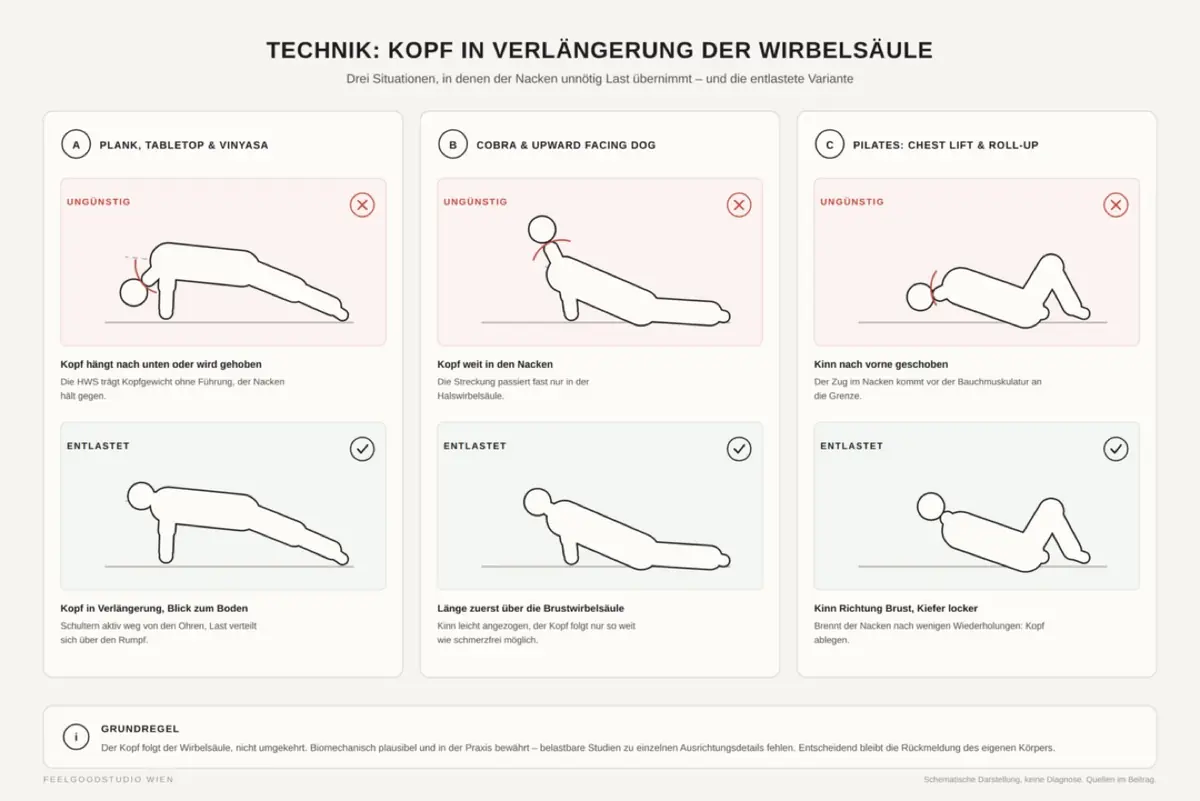
The head follows the spine. In weight-bearing positions it stays in line, with your gaze towards the floor. A chin pushed forward lengthens the lever without improving the position.
The gaze leads. Where the gaze goes, the head goes, and with it the alignment. That's not esoteric; it's the flip side of the orientation task described above. A calm, deliberately placed gaze makes the position more stable than a wandering one.
The shoulders help carry. Where the thoracic spine and shoulder girdle do their share, the neck has to compensate less. Shoulders actively away from the ears, jaw relaxed.
The dose counts. It's not only the angle that matters, but how long and how often. Two clean repetitions are worth more than ten in which the neck takes over.
And some context: these principles are biomechanically plausible and proven in practice. There are hardly any studies linking individual alignment details to fewer complaints. They are good rules of the craft, not proven protective measures. What counts is the feedback from your body in the position.
What yoga and Pilates can do for the neck
The good news is well supported: movement helps with persistent neck pain.
For yoga in chronic, non-specific neck pain, a meta-analysis pooled three randomised studies with 188 people. Compared with usual care, there were clear effects on pain intensity, impairment in daily life and quality of life.
Posture, phones and the neck — do I need to sit “straighter”?
In adults with neck pain, the head is on average positioned slightly further forward than in people without symptoms. The difference is just under five degrees. In adolescents, however, no such link has been found.
What's often more relevant than a supposedly perfect posture is not staying in the same position for hours. Changing position regularly and moving make more sense than trying to force a particular “ideal” posture all day.
What's different with phones
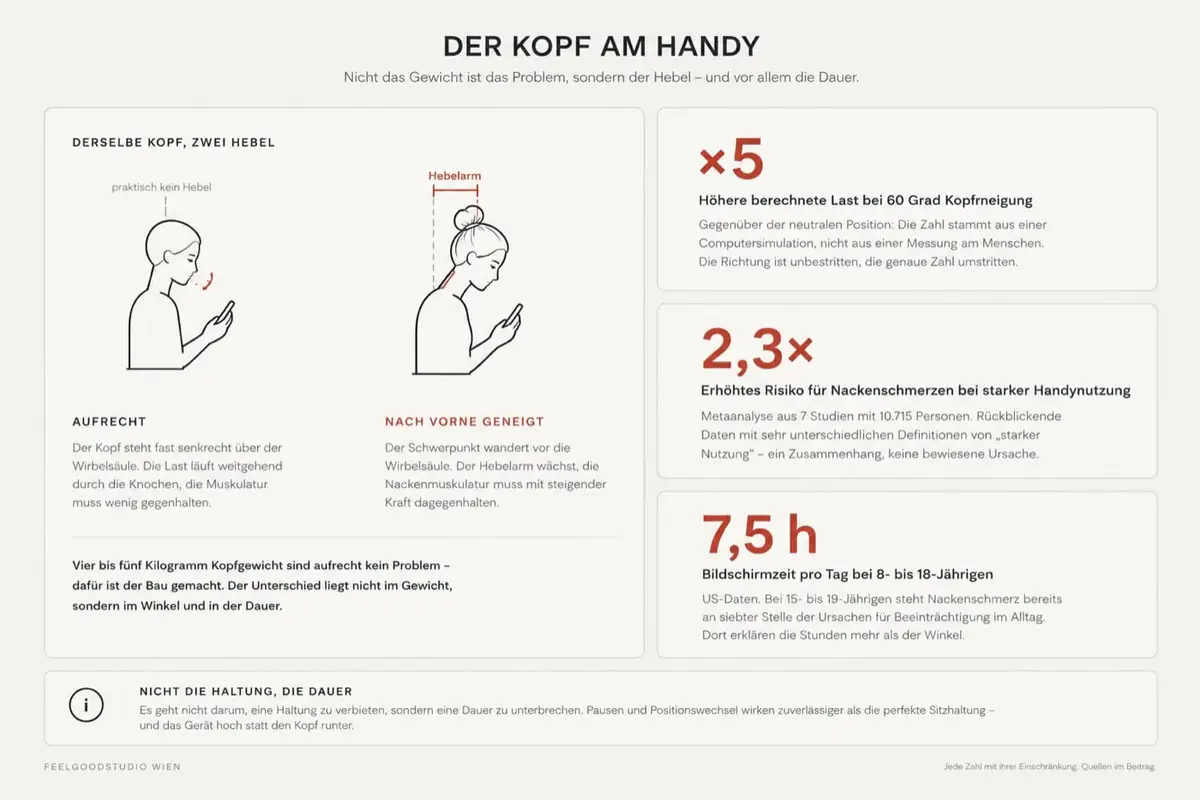
And yet there is a difference between sitting upright and bending low over a screen. It lies not in the weight but in the lever.
When you're upright, the head sits largely above the cervical spine. Its roughly four to five kilograms can then be carried largely by the bony structures; the neck muscles have to work comparatively little against it.
When the head tilts forward, its centre of gravity moves in front of the spine. The lever arm grows, and the neck muscles have to hold against it with increasing force. One frequently cited calculation model arrives at around five times the load of the neutral position at 60 degrees of head tilt.
A meta-analysis of seven studies with 10,715 people found a roughly 2.3‑fold increased risk of neck pain with heavy smartphone use.
A systematic review of 13 studies with 14,353 people aged 6 to 25 consistently found a link between screen time and neck complaints: less screen time went along with fewer complaints.
For scale: according to US data, daily screen time among 8- to 18-year-olds is around seven and a half hours. And among 15- to 19-year-olds, neck pain already ranks seventh among the causes of impairment in daily life.
What to make of “Tech Neck”
The term is popular, but it's not a recognised diagnosis. It was coined by a chiropractor.
The link it describes is still real, just dose-dependent. From around three to four hours of daily use, the risk rises.
In practice, this means: it's not about banning a posture, but about interrupting its duration.
What actually helps
- Breaks and changes of position beat perfect posture, even if that sounds less like a solution
- Raise the device instead of lowering your head: phone at eye level, laptop raised, external keyboard
- Movement to balance out the hours spent sitting anyway
The last point is where yoga and Pilates come in. Not because they correct a posture, but because they build load capacity and bring variety of movement into a daily life that has little of it.
When your neck hurts
Pain is a signal, not an opponent. If you have clear symptoms during practice, breaks or adjustments make sense:
- skip shoulder stand and plough or replace them with legs up the wall
- pause headstand
- in vinyasa, don't lift your head, gaze to the floor, keep your neck long
- practise Cobra and Updog lower, head in line with the spine
- in Pilates, rest your head instead of lifting your upper body, or support your head with one hand
- hold positions where you keep your head lifted for less time
- choose classes that work without headstand, shoulder stand and plough
If your neck is sensitive, a practice that works mainly standing is worth it for a while. Classes focused on standing positions, mobility, breathing and endurance put hardly any load on the cervical spine. Individual positions in them, such as Rabbit, put significant load on the neck and can be skipped.
Also important: the studios have blankets, blocks and bolsters that can be used free of charge. A folded blanket under the shoulders changes the angle in shoulder stand, and a cushion under the head provides relief when lying on your back and in twists. Just ask the teacher or the team on site before class.
And the point that most often gets lost: resting your head is the better option, not the weaker one.
When you should get it checked
The vast majority of neck complaints are harmless and get better. In most cases no single cause can be identified; this is called non-specific neck pain. That sounds unsatisfying, but it's actually the more favourable starting point: this form usually responds well to movement and adapted load.
The following signs suggest having your symptoms checked by a doctor or physiotherapist:
- numbness or tingling in the arm or hand
- loss of strength in the arm or hand
- pain radiating beyond the shoulder into the arm
- unsteady gait, clumsy hands or symptoms in both arms
- symptoms after a fall or accident
- dizziness, visual disturbances, speech or swallowing problems
- fever, unintended weight loss or a history of cancer
- pain at rest or at night, or no improvement over weeks despite adjustments
To be honest: these warning signs are based mainly on expert consensus, not hard data. A review of 29 guidelines found little agreement on which signs should be included. They are a reason to ask, not a diagnosis and not a reason to panic.
For a medical assessment or individual advice, you can contact our medical practice Feelgoodmedicine. There, your symptoms are assessed by a doctor and the next steps are discussed.
The most important rule: yoga doesn’t have to hurt. A good practice adapts to your body, not the other way round.
Our schedules: find the right class for youSee you on the mat,
🌸 Your Feelgood Team 🌸
Sources
- GBD 2021 Neck Pain Collaborators. Global, regional, and national burden of neck pain, 1990–2020, and projections to 2050. The Lancet Rheumatology 2024. — 203 million people affected in 2020, more often women, peak at 45–74 years.
- Hector R, Jensen JL. Sirsasana (headstand) technique alters head/neck loading. Journal of Bodywork & Movement Therapies 2015;19:434–441. — 40–48 % of body weight on the head; weight shifts away from the arms during the hold.
- Peng B et al. Cervical Proprioception Impairment in Neck Pain – Pathophysiology, Clinical Evaluation, and Management. Pain and Therapy 2021. — High spindle density in the deep and suboccipital neck muscles; interplay with the vestibular and visual systems; with neck pain, altered head position sense, balance and oculomotor control.
- Muscles of respiration (overview). — Scalenes active during quiet breathing; sternocleidomastoid recruited as breathing volume increases.
- Cramer H et al. Effects of yoga on chronic neck pain: a systematic review and meta-analysis. Clinical Rehabilitation 2017. — 3 RCTs, 188 people; SMD pain intensity −1.28; disability −0.97; quality of life 0.57; no serious adverse effects; short-term effects.
- Effectiveness of the Pilates method in patients with chronic neck pain: a systematic review with meta-analysis. BMC Musculoskeletal Disorders 2025. — 8 RCTs, 439 people; better than no treatment, no advantage over other exercise.
- Summarizing the effects of different exercise types in chronic neck pain. BMC Musculoskeletal Disorders 2023. — All types of exercise better than none; no type clearly superior.
- Mahmoud NF et al. The Relationship Between Forward Head Posture and Neck Pain. Current Reviews in Musculoskeletal Medicine 2019. — Adults: mean difference 4.84°; adolescents: no association; cross-sectional data.
- Red flags for potential serious pathologies in people with neck pain: a systematic review of clinical practice guidelines. Archives of Physiotherapy 2024. — 29 guidelines, little agreement; mostly expert opinion.
- Anatomy, Head and Neck: Cervical Nerves. StatPearls, NCBI Bookshelf. — Nerve roots C1–C7 exit above the vertebra of the same number, C8 below C7.
- Cervical Anatomy. Physiopedia. — Uncinate processes / joints of Luschka between the five lower cervical vertebral bodies; contribution of the atlantoaxial joint to head rotation.
In English
The neck is rarely the focus of a pose, yet it is involved in almost every one. This article explains why the cervical spine is special and what the limited research shows: in headstand, practitioners carried 40 to 48 percent of their body weight on the head, more the longer they held it. Four principles for your practice: the head follows the spine, the gaze leads, the shoulders share the load and the dose matters. We also look at posture and phone use, what helps when your neck hurts and when to get it checked.