25.3.2026
Why diaphragmatic breathing matters so much
Why diaphragmatic breathing matters so much:
Do you suffer from nagging shoulder pain even though you haven't injured yourself? Does your neck feel tense and you don't understand why it isn't getting better despite treatment? Do you feel bloated and exhausted? Do you struggle with reflux? Anxiety and feelings of tightness? Hip pain with no obvious cause?
Then read on.
These and many other kinds of pain can be triggered or maintained by ineffective breathing. When asked to take a deep breath, most of us pull our shoulders up to our ears. In this chest-breathing mode our neck and shoulder muscles work especially hard, which means we can develop symptoms such as neck and shoulder pain, because we overuse these so-called accessory breathing muscles. These symptoms are often seen in people with asthma, as they use these accessory muscles more than healthy people do.
So what is the difference between chest breathing and diaphragmatic breathing (belly breathing), and why does it matter how we breathe, as long as we fill our lungs with air? Why is there so much talk about diaphragmatic breathing, and why is it pushed so much in yoga, meditation and breathwork classes?
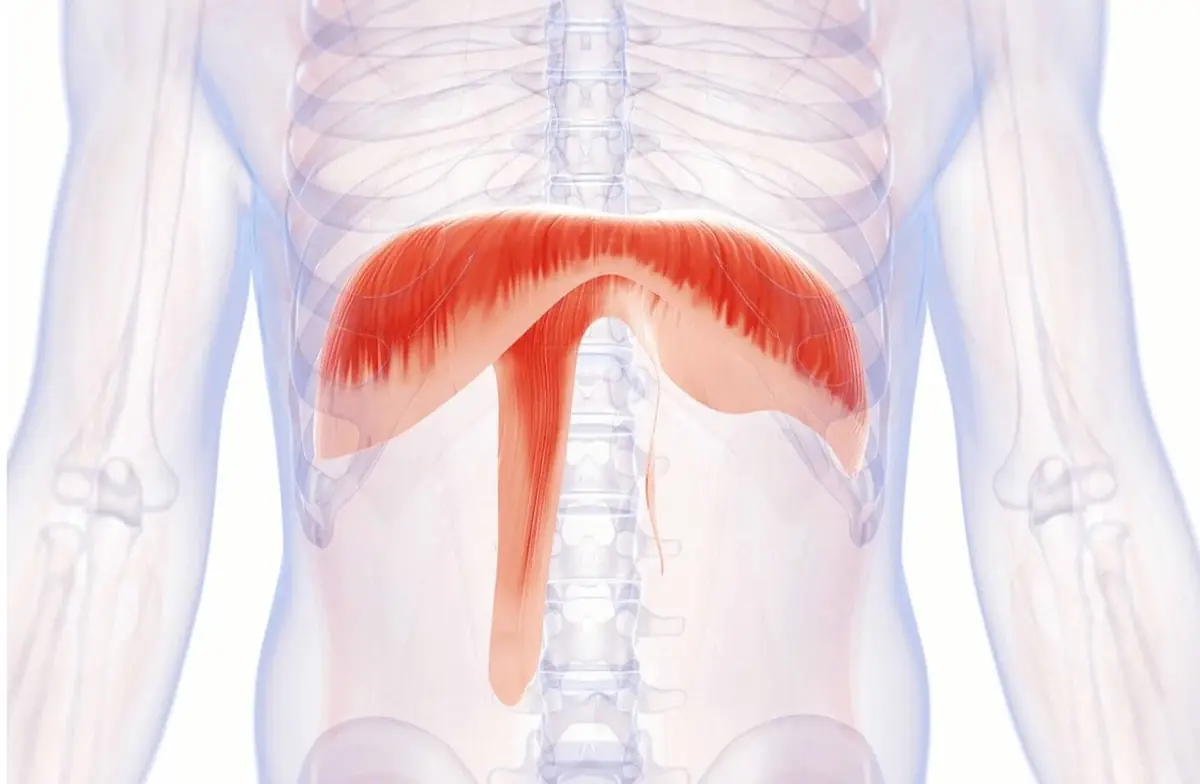
The diaphragm is a large, dome-shaped muscle that forms the floor of the chest. When you breathe in, it contracts and flattens, creating negative pressure so that air flows passively into the lungs. During quiet breathing it moves about 2–3 cm with each breath, and during deep breathing as much as 10 cm!
Practising diaphragmatic breathing has numerous benefits
• The up-and-down movement of the diaphragm has a pumping effect and moves the organs above the diaphragm in the chest (heart, lungs) as well as the organs below it in the abdomen (digestive organs such as the stomach and small/large intestine; liver, kidneys, pancreas and spleen, plus the pelvic organs) with every breath. Just as muscles and joints need to stay mobile to function optimally, organs also need to be able to move freely. If we don't use our diaphragm properly, organ mobility can become restricted, which can lead to problems such as venous and lymphatic congestion, digestive problems, reflux and reduced detoxification via the liver. A liver with restricted mobility can send pain signals to the spinal cord that the brain interprets as pain in the shoulder rather than in the organ. This so-called referred pain is why we can feel pain in the right shoulder that doesn't respond to any manual treatment, because the actual cause lies in the restricted mobility of the liver (which in turn can be a result of tension in the diaphragm).
• The diaphragm and the pelvic floor move in sync as we breathe. A restriction in the diaphragm often has a negative effect on how the pelvic floor works.
• Organs are firmly attached to the body wall by ligaments and fascia. If their mobility is restricted, this pull is passed on to the spine and muscles, which can lead to pain and stiffness.
• Proper diaphragmatic breathing plays a key role in returning blood to the heart against gravity. The suction effect of the diaphragm optimises venous return. Without this pumping movement, congestion can build up in the abdomen and legs.
• Diaphragmatic breathing is a central mechanism for directly stimulating the vagus nerve, which promotes calm and relaxation. Breathing deeply into the belly and exhaling slowly activates this nerve, lowering heart rate and stress hormones. Diaphragmatic breathing is an effective tool for self-regulation.
• Research suggests that a wide range of stress-related behavioural disorders and medical complaints, such as insomnia, panic disorder, generalised anxiety disorder, high blood pressure, headaches and non-cardiac chest pain, can also benefit from diaphragmatic breathing techniques.
This shows that the benefits of belly breathing go far beyond “getting more air into the lungs”. Diaphragmatic breathing affects every structure in our body, on an anatomical, physiological and emotional level. Breathing exercises and manual therapies such as osteopathy can help release tension and so have a positive effect on the body as a whole.
Written by Brita Graser, osteopath. More information at www.brita-bodywork.com