15.9.2026
Infrared heat at Feelgoodstudio 1150
INFRARED IN HOT YOGA: NEW HEAT AT FEELGOODSTUDIO 1150
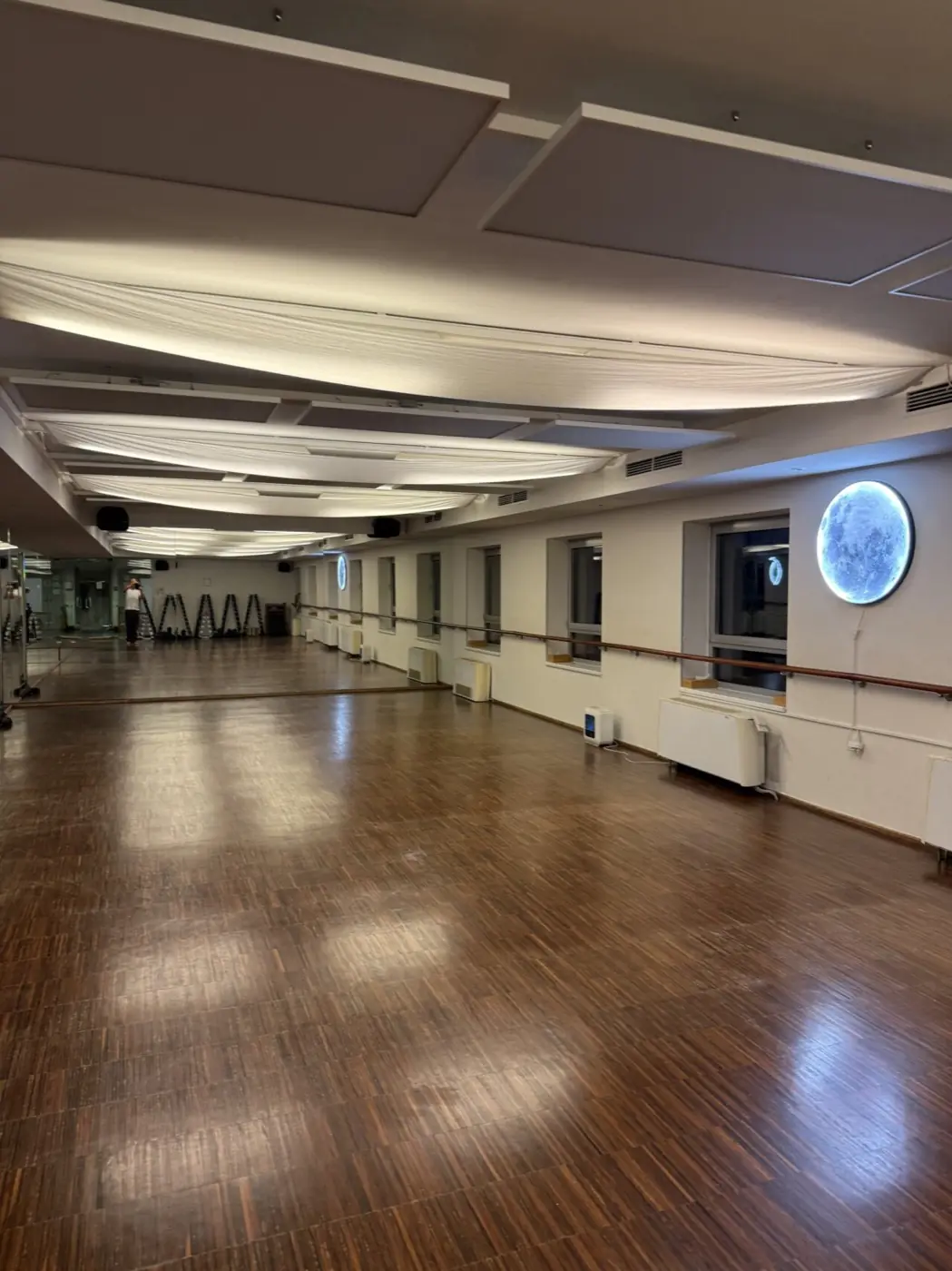
At Feelgoodstudio 1150 we have replaced the old electric ceiling heaters with modern infrared panels. Our practice room at Neubaugürtel is now heated in a different way: more evenly, more quietly and with a pleasant feeling of warmth on your skin.
The key differences:
- Much of the heat reaches you directly as radiant warmth, instead of only through heated room air.
- Bodies, mats, the floor and other surfaces absorb the radiation and then release the heat back into the room.
- This means the warmth can feel pleasant even when the air temperature is lower than with conventional warm-air heating.
- The infrared panels work without strong air circulation, so there is less moving air in the room.
HOW INFRARED HEAT WORKS
Infrared radiation is a form of thermal radiation. Unlike purely convective heating, it doesn’t heat all the room air first. The radiation hits bodies and surfaces and is absorbed there.
A simple comparison is a cool, sunny spring day: the air can still be fresh while the sun already feels warm on your skin.
This difference between measured air temperature and perceived warmth is exactly what matters with radiant heat. How comfortable a room feels thermally depends not only on the air temperature but also on the temperature of the surrounding surfaces and on air movement, among other things.
WHAT INFRARED HEAT DOES DIFFERENTLY
Warmth you feel directly
Radiant heat works the moment the radiation reaches your body. So you don’t have to wait for all the room air to reach a certain temperature first.
This can be especially pleasant when you arrive: you already feel the warmth on your skin while the room temperature is still building.
Pleasant warmth with less heated air
Radiant heat can help a room feel warm at a lower air temperature. That is one of the benefits of radiant heating for thermal comfort.
For a hot yoga practice this means: heat doesn’t have to feel like hot air only.
Even rather than spot heating
Our large infrared panels spread the radiant heat across the room. This creates a different feeling of warmth than individual spot heat sources.
How evenly the temperature is actually distributed always depends on room size, panel placement and output. So our goal isn’t simply “hotter”, but warmth that is as even and pleasant as possible throughout the practice room.
Less moving air
Infrared heaters don’t need strong air circulation to transfer heat. This means less convective air movement than with systems that actively distribute warm air around the room.
This can feel especially pleasant when you are lying on the mat and want little air movement.
Quieter
The panels themselves work without a fan, so the heating adds no fan noise.
What you hear is mainly your breath, your teacher’s cues and the music.
WHAT HEAT DOES IN THE BODY
Heat raises skin temperature and, among other things, widens the blood vessels near the surface. This changes blood flow to the skin and how you perceive warmth.
Flexibility can also change in the short term. Studies on yoga in a heated environment show that warmth can change certain flexibility measures more strongly in the moment. But that doesn’t automatically mean tissue becomes more “flexible” or less prone to injury in the long run.
That is why, especially in a warm class:
Use the heat to move more easily, not to force yourself further.
A bigger range of motion isn’t automatically a better one.
WHO MAY FIND THE HEAT ESPECIALLY PLEASANT
Hot yoga and Hot Pilates can be especially pleasant
- if you like to get moving with a bit of warmth in the morning or after sitting for a long time,
- if you enjoy intense movement and sweating,
- if you have liked warm rooms so far but find strong air movement unpleasant,
- if you especially enjoy the feeling of a warm, calm practice.
How heat feels is individual. What is pleasant for one person can already be too intense for another.
GOOD TO KNOW
Hot classes are physically demanding. Heat increases the load on the body’s thermoregulation. Dizziness, nausea, headaches or circulation problems are signs to take a break or leave the class. Such symptoms are also described in studies on hot yoga.
If you have cardiovascular disease, regularly take medication that affects your circulation or fluid balance, or have other health limitations, check with your doctor before a hot class whether this kind of strain is suitable for you.
PRACTICAL TIPS FOR YOUR FIRST CLASS AT 1150
Drink enough throughout the day. Not just ten minutes before the start.
Take your first hot class easy. You don’t have to do every pose at full intensity.
You can take a break at any time. Sitting on your heels, child’s pose or simply lying on your back for a moment – all completely fine.
Use the heat for clean movement. If a pose suddenly feels much easier, that doesn’t automatically mean you should go deeper.
Listen to your body. If you feel dizzy, nauseous, have a headache, unusual weakness or circulation problems: take a break, step out and cool down.
Let your teacher know if it’s your first hot class or if you have any health issues.
👋 Come by
Feelgoodstudio 1150, Neubaugürtel 47, 5th floor.
Questions: info@feelgoodstudio.at
With love,
🌸 Julie, Knut and your Feelgood Team. 🌸
SOURCES:
- Ali AHH, Gaber Morsy M. Energy efficiency and indoor thermal perception: a comparative study between radiant panel and portable convective heaters. Energy Efficiency. 2010;3(4):283–301. DOI: 10.1007/s12053-010‑9077‑3
- Janssen CW, Lowry CA, Mehl MR, et al. Whole-Body Hyperthermia for the Treatment of Major Depressive Disorder: A Randomized Clinical Trial. JAMA Psychiatry. 2016;73(8):789–795. PMID: 27172277
- Tsagkaris C, Papazoglou AS, Eleftheriades A, et al. Infrared Radiation in the Management of Musculoskeletal Conditions and Chronic Pain: A Systematic Review. Eur J Investig Health Psychol Educ. 2022;12(3):334–343. PMID: 35323210
- Nyer MB, et al. A Randomized Controlled Trial of Community-Delivered Heated Hatha Yoga for Moderate-to-Severe Depression. J Clin Psychiatry. 2023;84(6):22m14621. PMID: 37883245
- Hewett ZL, et al. Effect of a 16-week Bikram yoga program on perceived stress, self-efficacy and health-related quality of life. J Sci Med Sport. 2018;21(4):352–357. PMID: 28866110
- Brunt VE, Howard MJ, Francisco MA, Ely BR, Minson CT. Passive heat therapy improves endothelial function, arterial stiffness and blood pressure in sedentary humans. J Physiol. 2016;594(18):5329–5342. PMID: 27270841
- Charkoudian N. Skin blood flow in adult human thermoregulation. Mayo Clin Proc. 2003;78(5):603–612. PMID: 12744548
In English
In our studio 1150 at Neubaugürtel we replaced the old electric ceiling heaters with modern infrared panels. Much of the heat now reaches you directly as radiant warmth instead of only through heated air: more even, quieter and with less air movement. The article explains how infrared heat works, what warmth does in the body and who may find it especially pleasant. For your first hot class: drink enough throughout the day, take it easy and rest whenever you need to.